
 Up Here, by Tim Edwards. A road to Tuktoyaktuk…would open Canada up to its third coast, to the Northwest Passage and to vast stores of oil and gas….
 Alaska Dispatch by Yereth Rosen (NGP Photo).
| Petroleum News by Eric Lidji. The state is starting negotiations with MWH Americas Inc. to build a liquefied natural gas facility on the North Slope that would serve households across the Interior. |
The U.S. Bureau of Ocean Energy Management is reviewing Shell’s plans to finish the exploration well it started two years ago and drill up to five more in the potentially oil-rich but remote Chukchi.
On Tuesday, the agency sent a request to the company for additional information on what regulators say are safeguards needed for resumed offshore operations.
.JPG)
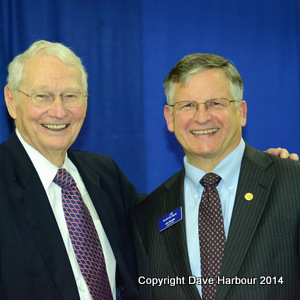 On January 15, Commonwealth North (CWN) Held Its Economic Reviews and Forecasts Meeting — A Date It Shares With National Hat Day. Subtlety and good fun are not lost on NGP readers, like Margy Johnson (NGP Photo), who came dressed for the occasion, and our good friend, Meera Kohler! Former CWN President and co-founder Max Hodel (NGP Photo) catches up with Joe Beedle after the meeting.
Reviews and Forecasts- Part 2 – Scroll Down for Part 1
Joe returned to give a highlight of the state’s financial assets that include the Constitutional Budget Reserve, Division of Economic Development, Alaska Mental Health Trust Authority, Alaska Industrial Development and Export Authority, Alaska Housing Finance Corporation, Division of Treasury, Alaska Permanent Fund, and the Statutory Budget Reserve Fund. Specific details can be found in the presentation notes on Commonwealth North’s website.
The unfunded liability of the pension funds is of great concern to the Governor and the state. At the current rate, the state will owe over $1 billion in payment in a few short years. This payment is nearly 20 percent of the total state budget. The Governor is proposing shifting $3 billion from savings to the pension fund, which will reduce the skyrocketing payments in the coming years and will result in significant savings over the life of the pension fund. The final part of the discussion centered around the State of Alaska’s enterprises, which include the Alaska Marine Highway, Alaska Energy Authority, Alaska Railroad Corporation, International Airports, Alaska Aerospace
option for students of all ages and experience. Campuses throughout the state and distance learning opportunities are making a college education more realistic for many Alaskans. The luncheon concluded by outlining the importance of our natural assets in respect to the oil investment tax structure and oil exploration and petroleum projects; our financial assets of the permanent fund percentage of value, long range fiscal plan and long range capital project planning, and finally; our enterprise assets investing in our critical infrastructure through railroad, airports, and energy and reliable, affordable energy for all Alaskans. The full presentation can be downloaded from the Commonwealth North’s website. http://www.commonwealthnorth.org/index.cfm?section=About&page=What's-New&viewpost=2&ContentId=840 Reviews and Forecasts- Part 1 – Scroll Down For Part II Posted: 17 Jan 2014 05:51 PM PST January is a time to reflect on the accomplishments of the past year and look forward to the future. It has been called a season for measuring things. In the past week, the Building Owners and Managers Association (BOMA) and Commonwealth North hosted luncheons with a focus on reviewing 2013 and looking forward to 2014. Both luncheons featured strong panels of speakers who shared their area of expertise with the audience. At the BOMA luncheon, Brian Meissner, of ECI/Hyer Architecture and Interiors, began by showing that 2013 was a strong year with the values of building permits going well above 2012. Permit values were at their highest level since 2006. He continued by giving an overview of new construction projects in Anchorage for 2014/15. There are a handful of new projects underway that will increase commercial space. He also noted that there was going to be a significant shift to renewal projects in the Anchorage School District. 2014 is expected to be a busy year, but with few surprises in the commercial real estate game. Next up was Northrim Bank’s, Mark Edwards to discuss commercial finance. He focused on the major paradigm shift that is being felt in the US in technology, banking, and real estate. Due to government interventions, it is hard to predict how the market is truly doing. It does not reflect the true supply and demand for goods and services. Rapid changes in technology are reshaping commerce. Banking has seen a drastic shift since the 1990s. The number of banks is down sharply, while the dollar amount in deposits has nearly tripled in the same time frame. Finally, real estate is facing challenges moving forward. Rising interest rates and changes in inflation create price concerns for the future. Brandon Walker, Pacific Tower Properties, gave the forecast for office, retail, and commercial space for the coming year. Anchorage’s office vacancy is very low and has continued to drop in the past four years. Many tenants are choosing to stay put unless they are displaced from their current location. Retail vacancy is well below the national average at just over 4 percent. National retailers still have a healthy appetite for Anchorage and focus their business in three major areas, the 5th Avenue Mall, Dimond Center and the power centers of Glen Square and Tikahtnu Commons. 2013 was a slow year for new national retailers, but 2014 is expected to pick up with the development of the Outlets of Alaska. The space is 65 percent pre-leased but retailers are waiting to announce their opening until further along in the project. Until then, the rumor mill will continue to turn as to what new stores will be landing in Anchorage. Industrial vacancy is even lower than office space. The challenges for industrial space include tenant fit/obsolescence, land scarcity, and new construction feasibility. Space will always be a challenge in Anchorage for new construction, and vacancy rates will continue to be low until price or construction costs justify new development. Closing out the BOMA luncheon was Neal Fried, Economist for the State of Alaska. Neal outlined the pattern of Boom, Bust, Recovery and Moderation in relation to the Alaska economy since 1980. The past five years have held steady after 20 years of growth from 1989 to 2008. 2013 was a modest year in employment, seeing a growth of approximately 500 jobs, down from an increase of 3,400 in 2012. Alaska is well above the national average for median household income and places fifth in the nation. If Anchorage were a state, it would sit at the top of the list with a median household income of $86,790, over $6,000 higher than the AK average. Neal predicted that 2014 would be another flat year for employment. He shared with the audience his record on what really happened versus his predictions over the past eight years. Every year, except one, he predicted the correct direction of growth or loss, and the greatest difference was in 2012 when he predicted a 0.6 percent growth when we actually saw a 1.7 percent growth. As you can see, there is a lot happening within Anchorage and while 2014 isn’t expected to be a record year, growth and development is heading upwards and there are exciting new projects on the horizon. For the complete presentations from the BOMA luncheon, please visit http://www.bomaanchorage.com/.
|
 … Commonwealth North joins the discussion by taking an in-depth look at Alaska’s assets from many different angles. The review reports on value, income, and prospects of Alaska’s key assets from the preceding fiscal year; in this case, July 1, 2012 through June 30, 2013. It also tracks performance of those assets and asset managers against pre-identified criteria and metrics.
.JPG) Joe Beedle (
.JPG) Ed Fogles (
_0.JPG) Commissioner Angela Rodell
.JPG) Corporation, and the University of Alaska. With the exception of the Aerospace Corporation, all enterprises showed growth in 2013. The enterprises highlight the unique landscape in Alaska. Pat Gamble (
 ADN

Leave A Comment