
The Bureau of Ocean Energy Management, Enforcement, and Regulation (BOEMRE) is accepting comments on the development of offshore oil and natural gas in Alaska's Chukchi Sea. With years of studying the potential impacts of production and ensuring all safety precautions have exceeded standards; and, with the country's need for domestic energy and jobs, we can make our views known today, here. The Chukchi is one source for replenishment of declining volumes of oil traversing the 2/3 empty Trans Alaska Oil Pipeline System (TAPS). A gas pipeline is important. But keeping TAPS operating is the #1 priority. Time spent debating gas pipeline issues today is time not spent filling TAPS tomorrow (Our commentary). -dh
Calgary Herald by Deborah Yedlin. There's been a good deal of consternation and surprise surrounding a Natural Resources Canada memo obtained by Postmedia that addresses the issue of pipeline capacity.
Yesterday, Jennifer Thompson of the Federal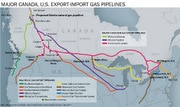 Coordinator' office wrote: "Today’s report from the Office of Federal Coordinator for the Alaska natural gas pipeline looks at how and where North Slope gas would move into Lower 48 markets. After reaching Alberta, the gas would flow into a vast network of Canadian and U.S. pipelines assembled over the past 60 years (See Federal Coordinator's Map). Some key components of that network were built or expanded in the early 1980s in anticipation of Alaska gas starting to flow back then. In all, the entire network today can move 15 billion to 20 billion cubic feet a day of natural gas, roughly three to four times the volume the Alaska pipeline would deliver to the British Columbia-Alberta border northwest of Edmonton. The network out of Alberta still moves billions of cubic feet of gas daily, but the volume has been declining, leaving room for Alaska gas. And even if the flow is relatively flush when the Alaska pipeline is finished, the network's capacity could be expanded. No longer is there serious talk of needing a pipeline stretching all the way from Prudhoe Bay to Chicago". See Bill White's story here.
Fairbanks News Miner by Bill Walker (NGP Photo). BP and ConocoPhillips’ Denali gas pipeline  project, proposing to take gas from Alaska to the Lower 48 markets, has been abandoned due to the long-term oversupply of gas in the Lower 48 resulting from huge shale gas finds. The project sponsors concluded that it did not make economic sense to continue with efforts to move Alaska’s gas to a collapsed gas market. … The key to Alaska’s future is in the robust world LNG markets and particularly in the premium Asian market. This is the market to which Alaska has been shipping LNG for the past 41 years. This is the market that the late Govs. Bill Egan, Jay Hammond and Wally Hickel and the late Sen. Ted Stevens pronounced as Alaska’s greatest opportunity for commercializing Alaska’s gas. While we wish and wait and subsidize a hopeless effort to force our gas into a saturated market through the AGIA process, companies such as Exxon, BP and ConocoPhillips are capitalizing on the lucrative opportunities in the world markets through the development of numerous LNG projects around the globe.
Comment on Bill Walker's OP-Ed above.
Just because Alaska has been exporting what has been very cheap–until recent years–Cook Inlet Gas to Japan doesn't mean export of LNG made from Alaska North Slope (ANS) gas is economically feasible.
ANS gas has a liability the Cook Inlet gas never had: just to get to tidewater where Cook Inlet gas is, someone has to pay for — or, talk someone else into paying for — an 800 mile pipeline.
Most competing LNG export projects around the world sell gas produced near tidewater. Most are in temperate (low cost) production areas. Most of them have much cheaper labor costs than we do. Even under the best of conditions, the Denali or AGIA overland projects could not have hoped to replace the jobs and revenue the state is losing with the 6-7% annual decline in oil production.
Note to Bill Walker:
If the "key to Alaska's future…", Mr. Walker, is to sell ANS gas to Asian markets, we should expect companies with a profit motive to execute LNG export contracts.
For 40 years, you and the governors you mentioned have touted the wonders of an uneconomic wasting of Alaska's treasury by government investment in an LNG export project the private sector hasn't touched with a 10-foot pole.
So now, while massive shale gas discoveries in North America and elsewhere have made gas more abundant you seem to suggest the export market for LNG will be more attractive than ever.
O.K., prove it. Use your sales ability to go out and put together a free enterprise project. Why squander more valuable time sounding the LNG gas export siren call for government investment or political solutions when you're perfectly capable of arranging for your own project funding and export contracts if your 4-decade-old scheme is as good as you believe it to be?
But, if Alaska's greatest economic threat and challenge is diminished Trans Alaska Pipeline System (TAPS) throughput, why don't we all join together to support Governor Parnell's sensible goal to increase production to a million barrels per day within a decade?
With your help, we could have a stronger voice combating federal overreach and domination over Alaska natural resource issues; and, your advice could be compelling to some Legislators who do not think production tax reform and investment climate improvement are essential keystones to increased production. -dh

Leave A Comment