
Calgary Herald by Stephen Ewart: Two pipelines, two countries: A waiting game without end
Young Republicans Sponsor Open Meeting To Hear Experts Discuss Oil Tax Reform
Report and Commentary
(We remind our readers that since accuracy of our archives is of primary concern, we solicit factual additions/corrections and will quickly make necessary changes. -dh)
by
Dave Harbour
.JPG) Last night at Anchorage's Loussac Library, Young Republicans had assembled a VIP Panel to brief the general public on an oil tax reform issue scheduled for a vote on Alaska's upcoming primary election ballot (NGP Photo: Young Republican President Michelle Hart).
Panel members…. (Scroll down for more or click here.)
Murkowski Holds FERC's Bay at Bay
Washington, D.C.–U.S. Sen. Lisa Murkowski, (NGP Photo),  .JPG)
“Bay’s responses to my questions on any number of important policy issues facing FERC did not provide the level of clarity needed to win my support,” Murkowski said. “Whether it’s where he stands on recusals, the cumulative impact of the EPA’s recent environmental regulations, or FERC’s current and future course his responses were not forthcoming or worse.”
| It’s official: 1 million barrels a day. Williston Herald. North Dakota crude oil production officially surpassed the 1 million barrels per day milestone. North Dakota became the fifth state to hit the million barrel mark, according to the North Dakota Petroleum Council. Alaska, California, Louisiana and Texas have previously hit the mark. |
The Senate Energy and Natural Resources Committee on Wednesday marked up the nominations of Bay and current FERC chairwoman Cheryl LaFleur, approving Bay 13-9 and LaFleur 21-1.
Murkowski has repeatedly voiced support for LaFleur’s nomination to a second term on the commission. She has also questioned why the president would demote LaFleur, the commission’s current chairwoman with more than 20 years of experience in the utility industry, to make Bay chairman.
“I am not interested in the chairman of the FERC doing on-the-job training, particularly when we have a woman – the only woman on the commission – who has been at the helm as the acting chairwoman, and by all reports from both Democrats and Republicans alike, she’s been doing a good job. She has been fair. She has been balanced. She has the temperament that we need. She has the personal qualities of leadership that we look for. She has the experience.”
Young Republicans Sponsor Open Meeting To Hear Experts Discuss Oil Tax Reform
Report and Commentary
by
Dave Harbour
Last night at Anchorage's Loussac Library, Young Republicans had assembled a VIP Panel to brief the general public on an oil tax reform issue scheduled for a vote on Alaska's upcoming primary election ballot (NGP Photo: Young Republican President Michelle Hart).
Panel members included:
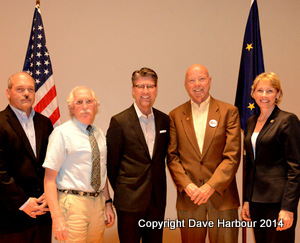 Panel moderator, Andrew Halcro (NGP Photo-Middle), Anchorage Chamber of Commerce President
- Alaska State Senator Cathy Giessel (NGP Photo)
- Former Anchorage Mayor Rick Mystrom (NGP Photo-Middle-R)
- Dr. Scott Goldsmith (NGP Photo-Middle-L), University of Alaska Anchorage Professor Emeritus of Economics
- Doug Smith (NGP Photo-L), the President and CEO of Little Red Services, an oilfield support services company is a former President of the Alaska Support Industry Alliance.
.JPG) Former Mayor Mystrom (NGP Photo) attracted and kept the audience's attention by first saying that he'd been following Alaskan issues for four decades and that, "this is the single most important issue I have seen in my Alaska life."
He said that if Alaskans vote to repeal their oil tax reform law (SB 21), oil production will continue declining. While oil companies have too much invested in the state to just "walk away", he said that reverting to the higher tax burden would deflect investments to other oil producing states and countries.
 Mystrom quoted the President of the State-owned Alaska Gasline Development Corporation, Dan Fauske (NGP Photo), as saying that if SB 21 is repealed in August, "the Alaska gas pipeline is toast."
All of our knowledgeable sources concur with Fauske's assessment because returning to a predatory tax structure in a world awash in rising oil and gas production creates huge barriers to what is, potentially, the most expensive construction project in history (i.e. $40 – 60 billion).
.JPG) Goldsmith (NGP Photo) refuted claims of some critics that the new tax reform bill is a "$2 billion giveaway" to oil companies, pointing out that the state was in deficit mode before passage of SB 21. If the long run is not taken into consideration, including enhanced employment, exploration and development arising from SB 21, one could only claim that the state is reaping $88 million less under SB 21 than under ACES.
.JPG) Smith pointed out that the decision to keep or repeal Alaska's year-old oil tax reform law is one of the biggest decisions in Alaska's history, "…and we need to get it right". Using his own small business as an example, Smith said that work had dramatically increased following passage of SB 21 a year ago. He said that his company was doing more work and producing more jobs than in his company's entire history.
He said that new oil and gas field work has now risen to about twice the level (i.e. about 14 drilling rigs) than existed before passage of SB 21 (i.e. about 6 drilling rigs).
Smith also noted that due to increased Alaska North Slope work, the decline rate in oil production is at its lowest level in six years.
.JPG) Senator Giessel (NGP Photo) addressed the argument of some that, "it's our oil" (NGP
 Photo), resulting in a mindset to tax that commodity to the hilt.
But when Alaska provides leases on oil producing tracts in return for cash bonus bids, for example, and lease holders find oil, the majority of the oil, she said, becomes "their oil" by virtue of lease agreements which only preserve about an eighth of the oil as a state royalty.
Of course, Alaska then adds to the producer's burden an income tax (in addition to federal income tax), a property tax and a production tax–the latter one of which is the subject of SB 21 tax reform.
Giessel traced the history of recent oil tax laws, pointing out that with lower taxes come a higher number of drill rigs exploring for oil. She compared the almost 30 rigs at work in Alaska today — following tax reform — with the dozen rigs operating in 2011.
She said that according to a recent study by the McDowell Group, the oil industry was responsible for over 110 thousand direct and indirect jobs in the state (i.e. 33% of total jobs), along with over $6.4 billion in wages (i.e. 38% of total wages) and billions in royalties and taxes.
 ACES (Alaska's Clear and Equitable Share) was the production tax law created by Governor Sarah Palin (NGP photo) and a bipartisan majority of the Legislature, in late 2006. The tax increase was enormous and created hastily, in the wake of a scandal involving several legislators and an oil industry support company a decade ago.
SB 21 is the oil tax reform production tax bill at issue this summer, enacted last Spring after four years of committee hearings and debate on how to improve ACES.
.JPG) Halcro pointed out that, "under ACES, it just didn't make sense for companies to expand." Expansion is the best way to produce oil, he said, not simply trimming expense. He reminded the audience that when oil companies make more money in a state dependent on oil jobs and income, everyone does better. He gave as an example, ExxonMobil, which is the single largest holding in the Alaska Permanent Fund.
Halcro also documented how the State Revenue Department overstated prospects for future oil production before the full, economic effects of ACES materialized into a disappointing and dangerous trend downward.
During a question and answer period following the presentations, Smith said in response to the hurried way ACES was created, "We can't make decisions like ACES on emotion." The crowd applauded.
 Responding to a question about why ACES passed in the first place, Halcro said it was a combination of lawmakers who didn't like oil companies and lawmakers who were afraid to vote against a popular governor (i.e. Palin). He noted that Representative Ralph Samuels (NGP Photo) was a courageous exception to the rule," another comment resulting in applause.
Halcro also noted that ACES included tax and investment incentives for small companies. But after two years and many millions in incentives had been dedicated to these companies, they told the state that though they could discover new commercial reserves, they could not afford to produce them under the tax burden imposed by ACES.
Halcro added that since the passage of ACES in 2006, Alaska's spending has risen 50% but its income has dropped 30%.
Halcro pointed out that the state is home to some 6,000 non profit corporations. (i.e. This is a higher per capita density of non governmental organizations (NGOs) than anywhere in the country if not the free world.) As government grants decline, Halcro said, these NGOs become more dependent on business and individual giving. As the saying goes, he said, "when the oil industry catches a cold, everyone else sneezes.
Earlier this year we editorialized on this issue and provided these statistics, concluding that, "We continue to be surprised at how few non profit organization leaders testify to the Legislature in support of oil companies, how few write letters to the editor. Yes, Non profits are professional, profligate writers of corporate and foundation grant requests, but how many stand up to support oil company investment — which directly and indirectly affects their own prosperity?
* * *
In another recent presentation, Dr. Goldsmith opined on various strategic alternatives for Alaska's economic future:
-30-
* * *
Additional Event Photo:
.JPG) Young Republicans
with 6-18-14 SB 21
Panel Members

Leave A Comment