
Oil and Gas Journal, by Christopher E. Smith. ExxonMobil 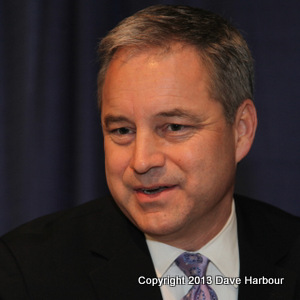 Corp., BP PLC, ConocoPhillips, TransCanada Corp., Alaska Gasline Development Corp. (AGDC), and Alaska's commissioners of natural resources and revenue have signed a heads of agreement (HOA) for the Alaska LNG Project, laying the commercial framework for development of an 800-mile natural gas pipeline to transport production from the Alaska North Slope (ANS) to a 15-18 million tonne/year LNG plant on its south-central coast. The HOA is subject to public review by the state legislature this session. Alaska Gov. Sean Parnell (NGP Photo) described the agreement as "historic" saying it would allow pipeline development "on Alaska's terms and in Alaskans' interests."
|
Executives from two leading energy consumers have taken leadership positions on Consumer Energy Alliance’s (CEA) eight person |
 CNBC:
.JPG) board of directors, the organization’s president David Holt (NGP Photo, above) announced today. Nucor Corporation executive Jennifer Diggins (NGP Photo) will serve as chairwoman and Wayne Zemke (NGP Photo), a
 marketing executive with Caterpillar, Inc., will serve as vice chairman. Diggins’ term follows two successful years for CEA under the leadership of John Heimlich (NGP Photo), a vice
 president and chief economist for Airlines for America. Heimlich will continue to serve as a member of the board. CEA is made up of over 240 member companies and over 400,000 citizens who support boosting an “all of the above” energy policy.
Today's Consumer Energy Alliance energy news links:
Consumer Energy Alliance’s The Energy Voice: Energy key to solving income inequality
When exploring solutions to income inequality policy makers pay close attention to the costs. The cost of healthcare. The cost of food. The cost of child care. The cost of housing. What about the cost of energy? According to the Bureau of Labor Statistics, in 2012 the average U.S. family spent over $4,600 or about 9 percent of their budget to heat and power their homes and fuel their vehicles. Families in the bottom fifth of income earners spent nearly 33 percent more of their budget on energy costs than average $2,500 a year or 12% of their annual budget.
Reuters: UPDATE 1-Obama touts 'responsible' energy development measures, climate goals
President Barack Obama told lawmakers on Tuesday his energy strategy had boosted the economy and reduced carbon emissions, but he did not address the question of whether he will approve the politically charged Keystone XL oil pipeline. In his annual State of the Union address, Obama touted the role natural gas had played in cutting U.S. greenhouse gas emissions and creating jobs. "The all-of-the-above energy strategy I announced a few years ago is working, and today, America is closer to energy independence than we've been in decades," he said.
National Journal: Administration Critics Keep Up Pressure Over Keystone
Conservative lawmakers in the House and Senate are keeping up the pressure on President Obama to approve the Keystone XL pipeline, despite the fact that the president made no mention of the project Tuesday in his State of the Union speech. Reacting to the speech, Sen. John Hoeven, R-N.D., an ardent proponent of the pipeline, which would ship crude oil from Alberta, Canada, to Gulf Coast refineries, said: "Although it is only one project, the Keystone XL pipeline illustrates the way the president is holding up our economy and discouraging real, private-sector job creation. The Keystone pipeline, and projects like it, will create millions of jobs…. Yet the Keystone XL pipeline has languished for five years in regulatory limbo, while millions remain jobless."
Miami Herald: Tar sands seen flowing to Northeast States if pipelines are built
In contrast to regions such as the upper Midwest, the U.S. Northeast's fuel supply has been nearly free of tar sands crude. That may change in coming years if pipeline expansions sought by Canada's industry proceed, an environmental group is warning. An increase in the consumption of gasoline made from tar sands, with its bigger carbon footprint, "would move the region backwards in its efforts to fight climate change," said a report by the Natural Resources Defense Council. The advocacy group is a leading critic of Canadian plans to expand production and shipment through new pipelines, including the Texas-bound Keystone XL system.
The Canadian Press: Pipeline workers grow anxious of Keystone XL standstill
There’s a clan of semi-nomadic tradesmen quietly watching for a sign that, somewhere on the horizon, there might be a resolution to the Keystone XL dispute. The Berringer brothers have travelled far, and often, to build pipelines like their dad did. Between the now-retired father and his two burly boys, their total combined experience adds up to about a century. And in all that prodigious pipeline-laying history, they say, not once have they ever witnessed a struggle like the one Keystone XL.
USA Today: Poll: Slight Majority Backs Keystone XL Pipeline
A slight majority of Americans favor the controversial Keystone XL oil pipeline that President Obama is expected to approve or reject this year, finds a poll conducted for USA TODAY. About 56% say they favor the northern leg of the billion-dollar, Canada-to-U.S. project and 41% oppose it, according to the poll of 801 U.S. adults completed last month by Stanford University and Resources for the Future (RFF), a non-partisan research group.
Associated Press: Va. biz leaders, legislators take aim at EPA
Eighty-five members of the General Assembly have added their names to a letter to President Barack Obama, expressing their opposition to proposed regulations to limit carbon emissions at new coal-fired power plants. Delegate Terry Kilgore said the letter released Tuesday is intended to send the message to Obama and the Environmental Protection Agency that the proposed regulations are "reckless and irresponsible" and will cost Virginia jobs. The Republican represents coal-producing counties in southwest Virginia. The American Lung Association responded in a statement that called power plant pollution a public health problem. The Sierra Club supports the new rules.
E&E News: Obama vows action on energy, climate, higher wages and manufacturing hubs — with or without Congress
President Obama had a clear message for Congress last night: I don't need you. Bruised after several years of congressional inaction on some of his top legislative priorities, Obama laid out plans in his fifth State of the Union address to go it alone on issues like combating climate change, speeding up transportation infrastructure projects and hiking the minimum wage for federal contractors. Obama did ask Congress for some big-ticket legislation like transportation infrastructure and water resources bills, the repeal of $4 billion in annual subsidies to the oil industry and policies aimed at shifting vehicles from using oil to natural gas.
Roanoke Times: Ahead of Obama's speech, Southwest Va. legislators blast proposed EPA rules
On the day of President Barack Obama’s State of the Union address, Southwest Virginia legislators and coal industry advocates gathered in Richmond to blast the administration’s proposed regulations on greenhouse gas emissions from power plants. “These regulations are so unrealistic, they literally make it impossible to build a new coal-fired power plant in the United States,” said Del. Terry Kilgore, R-Scott County. “The technology simply does not exist out there to meet what these regulations would demand.”
The Hill: Natural gas big winner in Obama SOTU address
While standing by his "all of the above" energy strategy on Tuesday night, President Obama gave a big hat tip to natural gas production. Obama credited natural gas as one of the key factors in bringing the U.S. closer to energy independence for the first time in decades. "The all-of-the-above energy strategy I announced a few years ago is working, and today, America is closer to energy independence than we’ve been in decades," Obama said during his fifth State of the Union speech on Tuesday. "One of the reasons why is natural gas – if extracted safely, it’s the bridge fuel that can power our economy with less of the carbon pollution that causes climate change," Obama said.
E&E News: Obama pursues Steel City credentials in Marcellus gas country
With the State of the Union speech behind him, President Obama today is heading to a U.S. Steel Corp. plant near Pittsburgh, where he'll also stand on top of the region's sprawling natural gas formation. From U.S. Steel's Irvin Plant, rolled steel is shipped to the nation's expanding auto manufacturers. In and around Pittsburgh at the epicenter of a dramatic industrial collapse three decades ago, the president's visit comes as Democrats and Republicans heading into congressional midterm elections try to capitalize on the region's economic resurgence. High-efficiency steel produced in the region — with the help of relatively cheap natural gas — will go toward making better cars that burn less oil, the president noted.
Energy In Depth: Shale Forces OPEC Member to Consider Importing U.S. Gas
Abundant supplies of natural gas — unlocked by hydraulic fracturing and horizontal drilling — are helping to lower home heating bills, create millions of jobs, boost American manufacturing, and deliver tangible environmental benefits. And yet for all of the known benefits of shale, the scale of its transformative power may not have been fully understood until this week. In a historic moment for American energy, a leader from the United Arab Emirates — a member of OPEC — announced that the UAE is “seriously thinking” of importing North American natural gas.
Pittsburgh Business Times: Cold weather adds to bullish outlook for natural gas
The cold weather we're having has been heating up natural gas prices to the highest levels in nearly four years. Bloomberg reported on the prices last week that were $5.442 per million British thermal units, thanks to the cold weather that has been hitting the Northeast. But prices have fallen about 6 percent since then, with forecasts of warmer weather in February than the cold this week. “Even though the price of natural gas is cyclical and can vary widely, the recent increases are good for the shale industry,” said Kathryn Klaber, former CEO of the Marcellus Shale Coalition and principal of environmental consulting firm The Klaber Group in Sewickley.
San Antonio Business Journal: Valero spending $730 million so two Texas refineries can process more Eagle Ford crude
San Antonio-based Valero Energy Corp. will spend $730 million to upgrade a pair of its Texas refineries so they can process additional crude from the nearby Eagle Ford Shale. Valero, the nation’s largest independent refiner, will pump $390 million into its Houston refinery and another $340 million into its Corpus Christi plant, equipping them to process more South Texas light sweet crude, company spokesman Bill Day says.

Leave A Comment