
Mackenzie Project Delayed Again!
Financial Post, CBC, Calgary Herald, Vancouver Sun
ADN – AP. 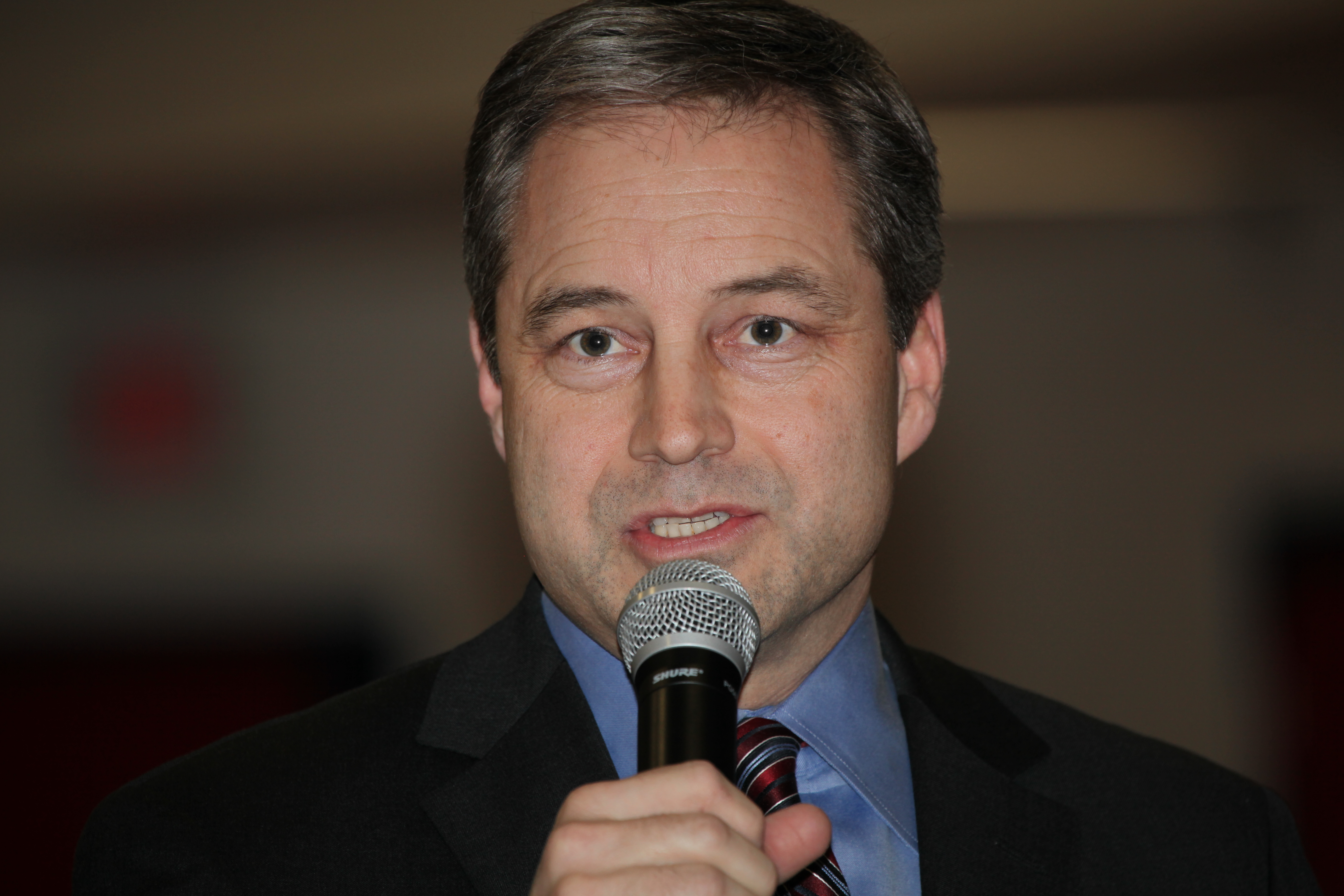 Gov. Sean Parnell (NGP Photo) said miners face an uphill battle against federal regulators, and his office is "fighting with everything we’ve got" against the feds and "overzealous" environmental groups. (See Governor Parnell’s earlier defensive effort to oppose the Federal government’s pattern of abusive rulemaking, litigation and anti-civilization initiatives: Juneau. Parnell challenges EPA resource rulemaking. * Governor fights Corps of Engineers NPRA decision. * Parnell opposes NOAA’s Beluga designation. * DOL intervenes in 9th Circuit against environmental activist challenge to DOI’s Chukchi decision. * State intervenes in OCS litigation. State intervenes support the National Marine Fisheries Service’s (NMFS) decision not to list the ribbon seal as a threatened species under the Endangered Species Act (ESA) * Parnell opposes NOAA’s Beluga designation. * Governor fights improper use of Endangered Species Act. * Governor supports responsible OCS work. * Parnell says, "Alaska is America’s Arctic energy breadbasket." * Lastly, review our critique of this ‘death by a thousand cuts’. -dh)
NARUC. The National Association of Regulatory Utility Commissioners (NARUC) sent a letter to President Obama late last week documenting the completion of their study to determine the social, economic and environmental costs to American citizens of maintaining oil and gas moratoria on millions of acres of lands with high estimated reserves of natural gas and oil. The study quantifies costs in terms of lower energy supplies, higher energy prices, lower gross domestic product, fewer domestic jobs and the export of wealth to foreign energy producers. (See our earlier report on Energy Council briefing here and a recent World News video.)
 ADN. Former U.S. Sen. Ted Stevens (NGP Photo-l; see video here) said Friday there’s not enough market for Alaska natural gas in the Lower 48 to justify a pipeline through Canada, and that the state should instead pursue construction of pipelines to Kenai and Valdez to export gas to Asia. KTUU. "Our state has the power to set aside AGIA and become — and decide to encourage the development of the bullet line as soon as possible," Steven said. "I believe emergency power should be given to a special coordinator to devise ways to get the main pipeline
 from the North Slope to Valdez built in record time." * KTUU.com. Former Sen. Ted Stevens spoke out on the future of Alaska’s natural gas at a speech to industry leaders Friday. In a surprise twist, he says he’s changed his mind on how to tap the state’s gas resources. Stevens says the state is losing focus, but he says he’s honed in on some ideas that need changing. "I tried to do everything I could to accelerate the pipeline through Canada to those states," Stevens said. "I’ve now changed that position." Stevens is now voicing his support for an in-state gas pipeline and the bullet line. Stevens previously spoke out in favor of the Alaska Gasline Inducement Act’s planned pipeline through Canada. "Our state has the power to set aside AGIA and become — and decide to encourage the development of the bullet line as soon as possible," Stevens said. "I believe emergency power should be given to a special coordinator to devise ways to get the main pipeline from
 the North Slope to Valdez built in record time." Stevens thinks the state should compete in growing liquefied natural gas markets along the Pacific Rim. He points out that demand for gas in the Lower 48 is expected to drop in the coming years, while the Asian market has a gap to fill. "Let’s move ahead," Stevens said. "We don’t need any more open seasons, we don’t any more periods for analysis — we
 need an emphasis on getting the job done." Bud Fackrell (NGP Photo-l), the president of the Denali pipeline project, acknowledges the volatile market in the Lower 48, but says the group will have a better ideaof what customers want after AGIA’s open season. "Our objective is to try to monetize the gas," Fackrell said. "Our plan is through a big pipeline, but there are some things that are outside our control. One of them is what is the market going to be in the Lower 48." (Event Photos-r, Commonwealth North President Joe Beedle with Stevens and members, Mike Felix and George Cannelos.) * KTVA by Matthew Simon. It appears up to $2 billion dollars could be on the line if lawmakers follow former Sen. Ted Stevens advice to toss AGIA’s big gasline aside in favor of the state shelling out half of the money for an in-state line.
Seward News, by Rep. Paul Seaton. …as a fallback, there is a fair amount of talk that the expense to convert the plant and bring it up to current regasification standards for importing LNG might by far be the cheapest short and medium term solution for supplying the railbelt energy needs…. (Commentary: We admire Rep. Seaton’s logical view of this issue. It is likely that constituents throughout Southcentral Alaska would prefer to burn cheaper molecules of IMPORTED natural gas than more expensive molecules of ANS gas, were the former to be–indeed–cheaper. -dh)
Commentary on the Steve Porter Blog (NGP Photo). Our friend, Porter, asks which pipeline project is best for Alaska and proceeds to give a mature critique of the current situation. I could only add to his comment that the project that is best is the one which succeeds in attracting investor interest and FERC certification. Beyond that, we pray that politicians and many screaming constituents with narry a bit of skin in the game will work harder to respect the private market by attempting to restrain themselves from the temptation to manipulate it using the power of government. -dh (See Dermot Cole’s, Fairbanks News Miner Comment.)
 ADN by Richard Mauer. Ethan Schutt (NGP Photo; see our original story), a senior vice president at CIRI, told the House Special Committee on Energy that the wind farm is projected to generate as much as 54 megawatts of power. That’s enough electricity for about 18,000 homes and a little bit more than the capacity of the natural gas turbines at Chugach Electric Association’s International Airport Road power plant in Anchorage, a relatively inefficient 1960s facility now used mainly for backup
Arctic Conferences. Tomorrow the Decho Economic Corporation will convene a ‘Decho Business Conference‘ in Hay River. Expected outcome of the conference is promoted as: "Dehcho First Nations communities will be in a better position to benefit from business development, business successes, employment, training and preparing for sustainable development as a result of participating in the conference and working forums. Support for sustainable development, keeping business in the North and preparedness for the anticipated Mackenzie Gas Project and potential set asides will be achieved through this event." Co-chaired by Cynthia Cardinal James, Chairperson, Dehcho Economic Corporation and Danny Gaudet, President, Deline Construction NWT, the agenda will include Katlodeeche First Nation Dene Drummers; Grand Chief Sam Gargan, Dehcho First Nations; Chief Roy Fabien, Katlodeeche First Nation; Dr. Manley A.  Begay, Jr., Ed.D., Director, Native Nations Institute; Randy Ottenbreit (NGP Photo), Development Executive, Mackenzie Gas Project; Joe Acorn, Consultant, Dehcho First Nations; Chief Clarence Louie, Osoyoos Indian Band; Perry Kocis, Senior Aboriginal Advisor, TransCanada Pipelines Limited; Mike Odell, Chief Financial Officer, Tåîchô Investment Corporation; Gilbert Cazon, General Manager, Nogha Enterprises Ltd; Merven Gruben, Vice-President, E Gruben’s Transport Ltd; Jack R. Blacksmith, President, Cree Regional Economic Enterprises Company; Catherine Twinn, Twinn Law, Sawridge First Nation; Helder Ponte, Director of Economic Investments, Ktunaxa Nation; Robb Campre, President, Maskwa Consulting Ltd.; Lisa King, Director, Industry Relations Corporation, Treaty 8 First Nations; Ken Smith, President, Northern Aboriginal Business Association; Pipeline Readiness Office, DIAND; James Pugsley, Resource Development Officer, Canadian Northern Economic Development Agency; Government of the Northwest
Territories; Gloria Buboire, ARHDA Coordinator, Dehcho First Nations; Mavis Wasp-Colin, ASEP Coordinator, Dehcho First Nations; Kevin Heron, Dehcho Liaison, Imperial Oil Ltd; Shane Parrish, Consultant, Dehcho First Nations; Shelly Anderson, BMgt, CAFM, PAED, In-Synch Consulting Ltd; Marnie Suitor, PAED, CMP, CMC, PFP, In-Synch Consulting Ltd.
And…while we’re thinking ahead, don’t forget the Inuvik Petroleum Show–perhaps a bit more business-oriented than the Decho Business Conference–scheduled for June 23 & 24.

Leave A Comment