
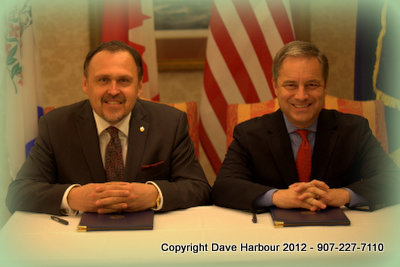
Governor Sean Parnell addressed national policy issues facing the three dozen oil and gas producing state members of the Interstate Oil and Gas Comact Commission yesterday in Vancouver, B.C.. Parnell is the 2011-12 Chairman of the Congressionally-created compact, supported by members of the Alaska Oil and Gas Conservation Commission, including Chairman Kathy Foerster. Following that address, he executed a Memorandum of Understanding with his Yukon Territory counterpart, Premier Darrell Pasloski (See story below).
ADN Columnist Tim Bradner gives well-deserved kudos to longtime, independent energy guru, Dick Peterson. He then opines on several ideas related to the fact that, "North Slope oil and gas producers are now focused on a large- diameter pipeline to a south Alaska port and a liquefied natural gas (LNG) export plant, thanks to Gov. Sean Parnell’s initiatives."
| The United States, Russia and Canada are among the governments limbering up for a “Great Game” in the Arctic. Boundary rights in the region are fuzzy, and potential benefits huge. Future conflicts over energy and other resources could turn nasty. An international effort to set firm rules is needed before it’s too late. |
Globe and Mail by Martin Hutchinson. Hillary Clinton, the U.S. Secretary of State, underlined American interest in the Arctic during a visit to Tromso in Norway on Saturday. Russia may reopen mothballed air bases, and Canada is considering boosting aerial surveillance. The U.S. Geological Survey estimates that the Arctic contains 13 per cent of the world’s undiscovered conventional oil and 30 per cent of undiscovered gas reserves. Energy is valuable and technology is making it more accessible, even in inhospitable places. Moreover, the Arctic icecap has shrunk by 35 per cent from the average for 1979 to 2000, opening new shipping lanes and making drilling and mining more practicable.
State Website. Late last month, Governor 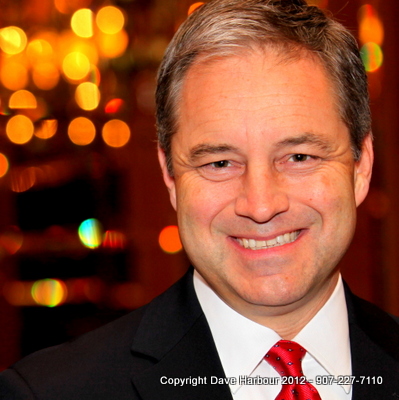 Sean Parnell (NGP Photo) signed legislation authorizing tax credits for exploration and drilling in remote areas of Alaska that show a promise of holding hydrocarbons. These areas include the Nenana Basin, the Yukon Flats, and Selawik Basin. The tax incentives for natural gas exploration, sponsored by Representative Steve Thompson, aim at the development of untapped resources with nearby communities in the Interior and Western Alaska that are in need of a local energy source. Parnell signed SB 23 at an event hosted by the Fairbanks Chamber of Commerce.

Leave A Comment