
Political cronyism should not govern tribal recognition
by
Elise Daniel
Press Secretary, House Committee on Natural Resources
The current tribal recognition process under the Bureau of Indian Affairs (BIA) is severely flawed, fraught with political exploitation and cronyism. Ahead of tomorrow’s markup on H.R. 3764, let’s take a closer look.
Take Michael J. Anderson and Kevin Gover, for example, both BIA Clinton administration appointees. In the waning days of the Clinton administration, they “quietly reversed” the recommendation of the Department of the Interior (DOI) historians and recognized three Indian tribes, granting them the opportunity to open casinos. Immediately after stepping down from their positions at the DOI, both Anderson and Gover entered lucrative positions representing gaming tribes. Interesting…
In 2001, the Boston Globe reported, “Gover personally rewrote the staff’s findings, inserting his own conclusions to affirm the tribe’s authenticity while editing out years of work by government historians, anthropologists, and genealogists.” Instead, he said he relied on his own “inference,” ignoring that the tribe did not qualify for federal recognition. Anderson also rejected the historians’ recommendations.
The kicker: Gover’s decision came at the same time the tribe was considering opening a casino. And he ruled, just five days before leaving office, that “that the tribe did not have to conduct an environmental impact study on a facility that would include 4,000 slot machines, a hotel, golf course, and water park, located about an hour’s drive from both Chicago and Milwaukee.”
A 2002 DOI report stated Gover acknowledged the decisions were political.
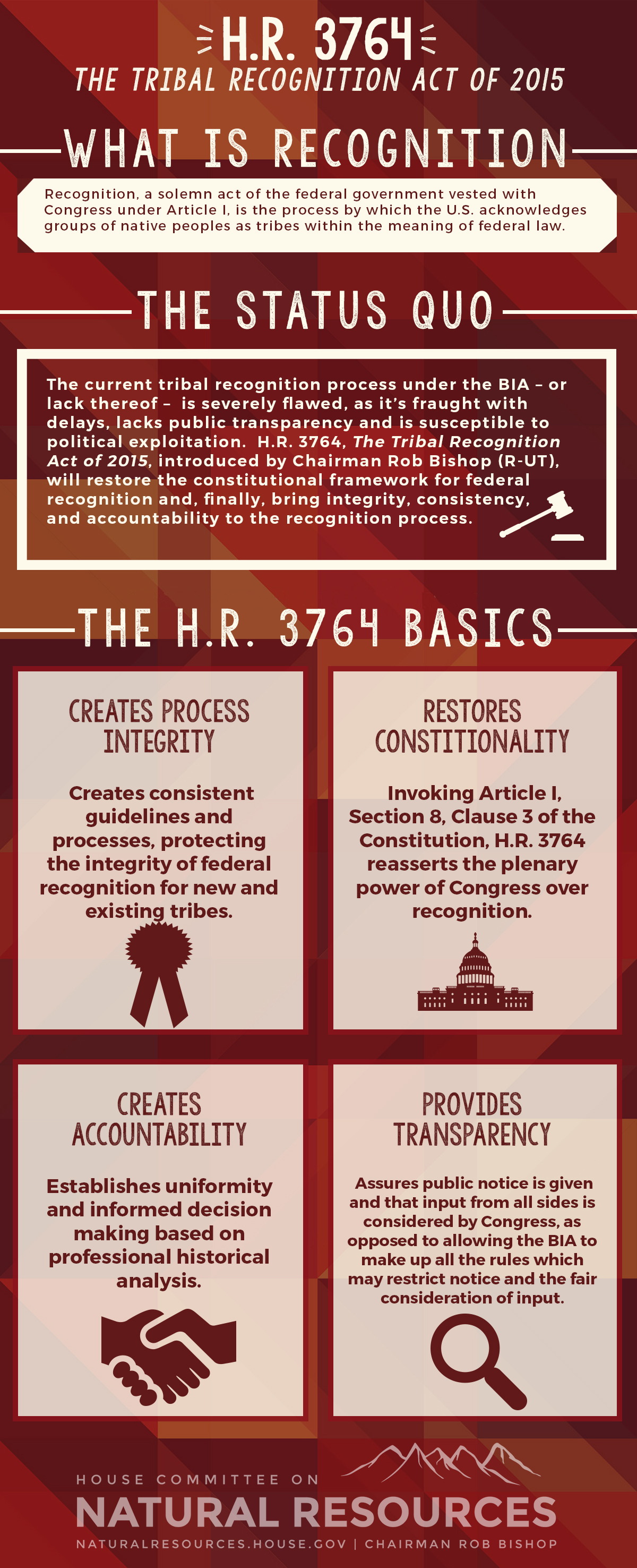
Recognition, a solemn act of the federal government vested with Congress under Article I, is fraught with delays, lacks public transparency and is susceptible to political exploitation. That’s why, tomorrow, the Committee will mark up H.R. 3764, the Tribal Recognition Act of 2015. This bill…
- CREATES PROCESS INTEGRITY: Creates consistent guidelines and processes, protecting the integrity of federal recognition for new and existing tribes.
- RESTORES CONSTITUTIONALITY: Invoking Article I, Section 8, Clause 3 of the Constitution, H.R. 3764 reasserts the plenary power of Congress over recognition.
- CREATES ACCOUNTABILITY: Establishes uniformity and informed, historical analysis.
- PROVIDES TRANSPARENCY: Assures public notice is given and that input from all sides is considered by Congress, as opposed to allowing the BIA to make up all the rules which may restrict notice and the fair consideration of input.
To learn more about H.R. 3764, click here for a summary and here for an infographic. Please reach out if you have any questions.
Elise Daniel
Press Secretary
House Committee on Natural Resources
1324 Longworth House Office Building
Washington, D.C. 20515
Alaskans Wishing For Their State To Become More Globally Competitive, Less Self Centered and More Economically Sustainable Should Pay Attention To This Viewpoint Of This Foreign Reader
Dave,

Leave A Comment