
The Oil Curse: Is It Real?
by
Dave Harbour
Our critical thinking readers can review this book (below), decide, then apply their conclusions to the oil, gas and minerals policies of Alaska and Western Canada (i.e. for starters).
If I were a philosopher prince, a student of Socrates and Plato, I would have absolute power, absolute integrity, a heart of wisdom and charity; and, I would be a good manager of natural resources.
 Realizing that both the production and price of resources is volatile, I would carefully husband and not become too dependent on its wealth during times of PLENTY. I would more highly value the jobs, freedom and lifestyles natural resources provide the kingdom than taxing the wealth to produce a bureaucracy within the court. By lightly taxing the resource I would be both encouraging more production and jobs while leaving the risks of volatility to the job-providing investors. I would be putting away a very small share of the produced wealth for 1) discretionary uses of the kingdom, and 2) for saving in anticipation of a time of SHORTAGE. All social welfare programs would be left to the judgment and kindness of all citizens, for it would be illogical to so heavily tax a volatile economy, then create on that brittle foundation of volatility a welfare state whose misery would be far worse for its dependence on taxation than were needy ones to depend on the charitable nature of citizens all along. One way encourages personal responsibility, creativity and prosperity while the other produces nothing but dependence, greed, unemployment and low production.
Finally, the kingdom ruled by my princely philosophy would be the kindest and most powerful of all alternatives, including a system which, by majority vote, greed, and no checks and balances, could so easily strip then redistribute the workers and investors of their earnings.
But what if the kingdom were not to have a philosopher prince — as many once thought President Washington could have been before he peacefully turned over the reins of power to President Adams? Well, the concept of a constitutional republic, with which we were blessed through the strength, enlightenment and determination of our founders, is as close to a perfect system as the world has ever known.
Accordingly, in absence of a Philosopher Prince, can we not best avoid the many curses of human leadership failings, while governing the wise use of our natural resources, by protecting our constitutional republic form of government against the self-serving demands of various special interests for a purely democratic form of government.
This is not only a debate between those who would tax resource producers to the max, and those counseling moderation. It is also the debate between those appreciating the United States’ Electoral College method of choosing a president, as opposed to a purely majority vote where the populous East and West coasts of a country can determine the fortunes and futures of the vast interior regions?
What think you? Comments below. -dh
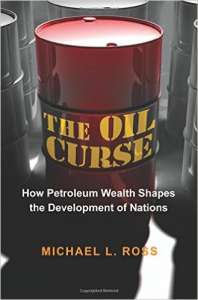
The Oil Curse: How Petroleum Wealth Shapes the Development of Nations
One may argue three law-like generalizations in political science: “no bourgeois, no democracy,” “democracies do not go to war with each other,” and “natural resources are a curse.” Although each of these highly contested arguments is important, the last one has the broadest impact—the negative effects of oil, natural gas, and mineral production go beyond authoritarianism and have economic, military, and societal consequences. Recently, some important publications have challenged the “resource curse” argument, creating doubts about these negative effects. In this regard, Michael Ross’s book is an extremely timely work. It not only responds to these critiques but also provides a consistent set of explanations about oil and its effects on authoritarianism, patriarchy, inter-state and civil wars, and economic underdevelopment. Ross has already written path-breaking articles on these issues and this magnum opus brings together his previous contributions with updated data, revised arguments, and fresh perspectives. Unlike his earlier publications, Ross’s analysis focuses on oil and natural gas, sometimes referring to both as only “oil,” and consistently leaves mineral production aside. His data show how the importance of oil will persist, if not increase, in the near future: “the global market for oil and other liquid fuels will rise from 86.1 million barrels a day in 2007 to 110 million barrel a day in 2035; the market for natural gas will rise from 108 to 156 trillion cubic feet” (p. 251).

Leave A Comment